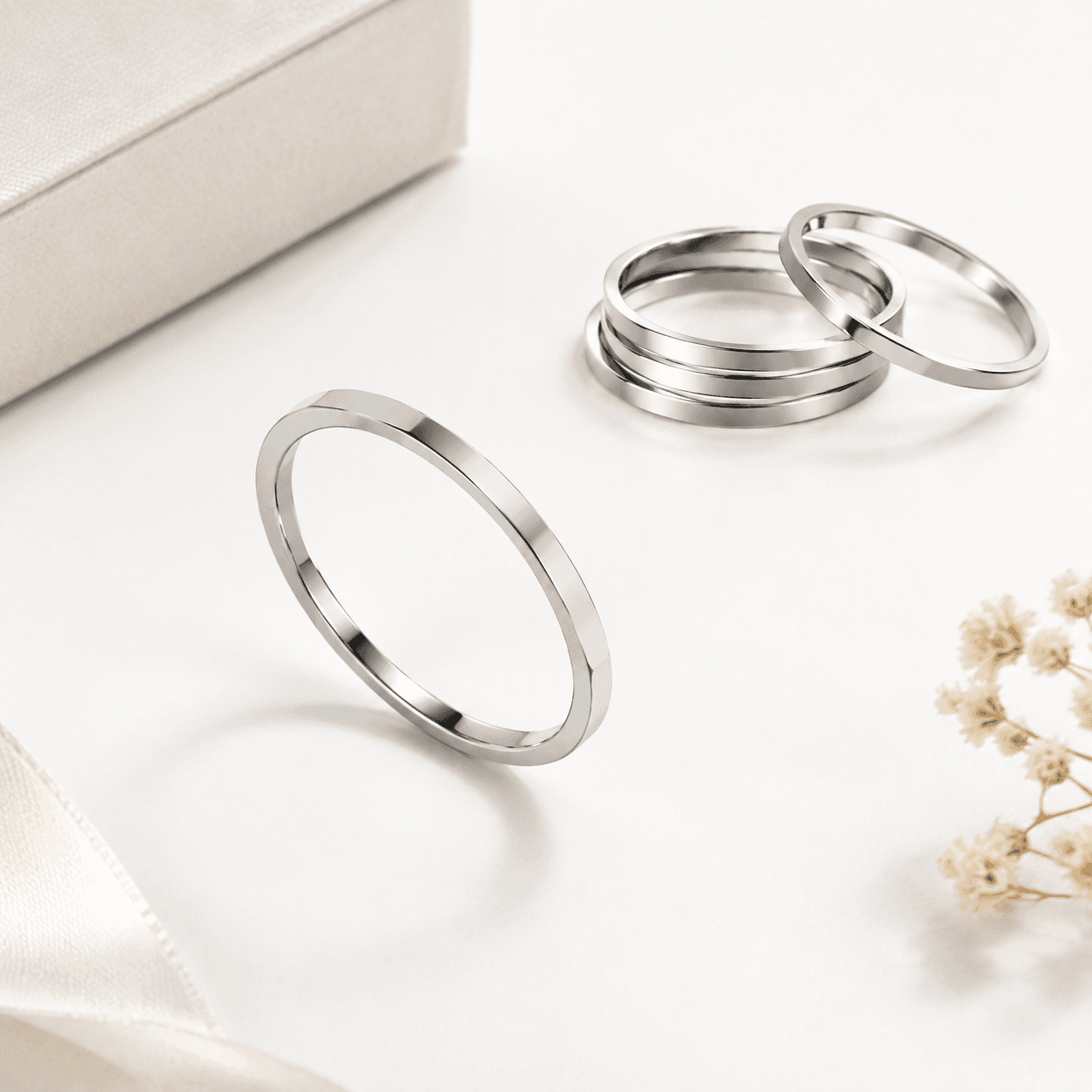
1mm stainless steel stackable rings are a minimalist jewelry option for retailers, wholesalers, and private label brands developing delicate everyday jewelry collections. Their narrow profiles work well as standalone pieces or as part of coordinated ring assortments. However, producing a commercially suitable slim ring requires more than selecting an attractive design. Band width, thickness, material grade, construction, surface finishing, sizing, and quality inspection all influence the finished product.
This guide explains the key specifications to evaluate when sourcing 1mm stackable rings, including 316L and 304 stainless steel, polished surfaces, PVD finishing, dimensional consistency, and custom packaging. It also outlines practical considerations for OEM and ODM development, from reference drawings and sample approval to bulk production specifications. Jewelry businesses can explore the stainless steel rings collection for product inspiration and assortment planning.
Warum 1-mm-Stapelringe eine praktische Ergänzung für Schmuckkollektionen sind
A 1mm stackable ring offers a minimal silhouette that complements contemporary jewelry collections. Its narrow band can be worn individually or combined with other rings, making it suitable for minimalist, layering, everyday, and gift-oriented product ranges. For jewelry retailers and private label brands, this versatility creates opportunities to develop coordinated collections with different finishes, sizes, and complementary designs.
However, a delicate appearance should not be confused with structural durability. A 1mm-wide ring has limited material across its width, and its resistance to deformation also depends on band thickness, geometry, material properties, and manufacturing quality. Buyers should therefore distinguish the stated band width from its thickness and cross-sectional profile when evaluating a product. These dimensions should be specified separately in technical drawings or sample requirements.
Stainless steel is one material option for developing practical everyday jewelry designs. Common sourcing choices include 316L and 304 stainless steel, although the appropriate specification depends on the intended product and market requirements. Finishing options may include polished stainless steel, PVD gold finishing, or configured rose gold finishes, subject to the manufacturing process. Buyers can explore the new design collection for additional product concepts when planning a private label or wholesale ring assortment.
For OEM and ODM projects, the initial design brief should establish the target dimensions, material, surface finish, ring sizes, and intended positioning. These details provide a clearer basis for evaluating manufacturing feasibility and developing a representative sample before bulk production.
Fünf technische Spezifikationen, die Sie bei der Beschaffung von 1-mm-Ringen prüfen sollten
1. Band width and thickness. A 1mm band width is approximately 0.039 inches. Because this is an especially slim profile, buyers should confirm the actual width and specify the band thickness separately. Product photographs are not sufficient for verifying dimensions. Request technical measurements and a physical sample when dimensional accuracy is important.
2. Edge profile and construction. Confirm whether the design uses a flat, rounded, or other specified edge profile. Examine the outer surface, inner opening, and overall circular shape. Edges should be consistently finished, without obvious irregularities. The agreed construction and dimensions should be documented before sample approval.
3. Stainless steel grade. Specify whether the proposed material is 316L stainless steel, 304 stainless steel, or another agreed material. Ask the manufacturer to confirm the material specification for the actual product rather than relying on a general stainless steel description. Any documentation requirements should be communicated during the RFQ stage.
4. Surface finishing. Polished stainless steel, PVD gold finishing, and rose gold finishing offer different visual appearances. Confirm the intended color, surface appearance, and finishing specification. Compare the production sample with the approved reference and inspect for visible marks, uneven color, or finishing inconsistencies. Performance requirements should be agreed separately rather than inferred from the finish name.
5. Ring sizing and dimensional consistency. Confirm the inner diameter, corresponding ring size, band width, thickness, and whether the design is a closed band or adjustable style. A consistent measurement method is important when developing multiple sizes for a wholesale collection. If adjustable construction is proposed, its feasibility should be reviewed against the design and intended use.
For commercial development, these specifications should form part of the sample approval checklist. An OEM or ODM jewelry manufacturer can review reference photographs, technical drawings, material preferences, finishing requirements, logo placement, and packaging details before confirming project feasibility. Learn more about available project coordination through OEM and ODM manufacturing services.
So bewerten Sie die Haltbarkeit und Qualitätskontrolle bei schmalen Edelstahlringen
Bei der Beurteilung der Haltbarkeit eines 1 mm breiten Stapelrings sollte die vollständige Produktspezifikation berücksichtigt werden, anstatt sich allein auf die Materialbezeichnung oder das Erscheinungsbild zu verlassen. Ein schmaler Ring kann unter punktuellem Druck anfälliger für Verformungen sein als ein breiteres Design. Sein tatsächliches Verhalten hängt von den Materialeigenschaften, der Ringstärke, der Querschnittsgeometrie, der Verarbeitung und den vorgesehenen Tragebedingungen ab.
Bei der Bewertung von Mustern sollten Käufer mehrere praktische Merkmale überprüfen:
- Maßhaltigkeit: Überprüfen Sie Ringbreite, Stärke, Innendurchmesser und Gesamtprofil anhand der freigegebenen Zeichnung oder Spezifikation.
- Formbeständigkeit: Prüfen Sie, ob der Ring seine vorgesehene runde Form ohne erkennbare Verformungen beibehält.
- Kantenbearbeitung: Kontrollieren Sie die Innen- und Außenkanten auf sichtbare Unregelmäßigkeiten und raue Oberflächenbearbeitung.
- Oberflächenqualität: Untersuchen Sie die polierte oder beschichtete Oberfläche auf sichtbare Spuren, ein ungleichmäßiges Erscheinungsbild oder Farbabweichungen.
- Konstruktion: Stellen Sie sicher, dass das fertige Muster dem vereinbarten Design und den strukturellen Anforderungen entspricht.
Bei Produkten aus 316L- oder 304-Edelstahl sollten Käufer eine Bestätigung der genauen Materialgüte anfordern. Die Materialauswahl allein lässt keine Rückschlüsse auf die Haltbarkeit des fertigen Rings zu. Wird eine PVD-Goldbeschichtung oder eine andere festgelegte Oberflächenveredelung gewählt, sollten auch das gewünschte Erscheinungsbild und die geltenden Prüfanforderungen dokumentiert werden.
Auf Fertigungsebene können die Qualitätskontrollpunkte eine Überprüfung der eingehenden Materialspezifikationen, Maßkontrollen, Formprüfungen, Kontrollen der Polier- und Oberflächenbearbeitung sowie eine Endkontrolle des Produkts vor der Verpackung umfassen. Zusätzliche Prüfungen oder technische Dokumentationen sollten entsprechend den Anforderungen des Käufers gesondert vereinbart werden. Eine Sichtprüfung sollte nicht mit Labortests oder unabhängig verifizierten Leistungsnachweisen gleichgesetzt werden.
Für Großhändler und Eigenmarkenunternehmen empfiehlt es sich, bereits vor der Musterfreigabe messbare Abnahmekriterien festzulegen. Dadurch lässt sich das freigegebene Muster leichter mit der anschließenden Produktion vergleichen und es können einheitliche Produktspezifikationen zwischen den Einkaufs-, Merchandising- und Qualitätskontrollteams kommuniziert werden.
Individuelle Veredelungen, Private-Label-Verpackungen und Kostenfaktoren im Großhandel
Bei einer kommerziellen Schmuckkollektion sollte die Präsentation eines 1-mm-Stapelrings gemeinsam mit seinen Abmessungen und seiner Oberflächenveredelung berücksichtigt werden. Zu den Verpackungsoptionen können einzelne Schmuckschatullen, Präsentationskarten, Schutzhüllen und individuell gestaltete Geschenkverpackungen gehören. Das geeignete Format hängt von der Einzelhandelspositionierung, der Zielgruppe, den Versandanforderungen und der beabsichtigten Produktpräsentation ab.
Private-Label-Kunden können verschiedene Verpackungsspezifikationen in Betracht ziehen, darunter die individuelle Platzierung von Logos, gedruckte Designs, die Gestaltung von Einlagen, Schachtelabmessungen und den individuellen Produktschutz. Bei aufeinander abgestimmten Kollektionen sollten die Verpackungsabmessungen sowohl den Ring als auch eventuell dazugehörige Schmuckstücke aufnehmen können. Fordern Sie vor der Freigabe Verpackungsreferenzen oder Muster an und bestätigen Sie, welche Komponenten im Angebot enthalten sind.
Großhandelspreise sollten anhand der vollständigen Produktspezifikation und nicht allein anhand der Ringbreite bewertet werden. Zu den wichtigen Kostenfaktoren gehören:
- Die angegebene Edelstahlgüte und der Materialverbrauch.
- Ringbreite, Stärke, Größenbereich und Konstruktion.
- Anforderungen an die Politur sowie die ausgewählte PVD- oder Galvanisierungsoberfläche.
- Logogravur und weitere Individualisierungsanforderungen.
- Verpackungsmaterialien, Druckdesigns und Einzelverpackung.
- Bestellmenge, Versandvereinbarungen und Zielmarkt.
Es gibt keinen einheitlichen Großhandelspreis für einen 1-mm-Edelstahlring, da unterschiedliche Spezifikationen und Bestellanforderungen zu unterschiedlichen Angeboten führen können. Käufer sollten bei einer Preisanfrage eine klare Produktbeschreibung und die geschätzte Bestellmenge angeben. Das Angebot sollte die geltende Produktspezifikation, Individualisierungskosten, den Umfang der Verpackungsleistungen und die Geschäftsbedingungen aufführen.
Prüfen Sie vor der Aufgabe einer Großbestellung außerdem die Zahlungsmodalitäten, Produktionsbedingungen, Versandverantwortlichkeiten, Kundendienstkontakte und schriftlich festgelegten Verfahren für fehlerhafte oder nicht konforme Produkte. Weitere Informationen zum Unternehmen finden Sie unter Informationen zur Fabrik und zum Unternehmen von Lefeng Jewelry.
Häufig gestellte Fragen zu stapelbaren Ringen aus 1 mm Edelstahl
OEM- und ODM-Entwicklungsprozess für maßgefertigte dünne Edelstahlringe
Developing a commercially suitable 1mm stackable ring requires coordination between the design concept, material selection, dimensional requirements, and manufacturing feasibility. For OEM and ODM projects, a clear development process helps buyers evaluate the proposed design before committing to bulk production.
Step 1: Submit the product brief. Identify the intended market, design concept, target band width, thickness, ring size range, preferred material, surface finish, estimated order quantity, and packaging requirements. Reference photographs, sketches, CAD drawings, or physical samples can help communicate the intended appearance.
Step 2: Review technical feasibility. The manufacturer should review the proposed dimensions, edge profile, construction, material specification, and selected finishing process. For an especially slim 1mm design, band thickness and structural requirements deserve particular attention. Any adjustments needed for manufacturing should be discussed before sample development.
Step 3: Develop and evaluate samples. A sample provides an opportunity to inspect actual band width, thickness, inner diameter, edge consistency, surface smoothness, and finish appearance. Buyers should also review requested logo details and packaging compatibility. Any revisions should be documented and approved before production specifications are finalized.
Step 4: Confirm production and inspection requirements. Once the sample and specifications are approved, the buyer and manufacturer should agree on the applicable material requirements, dimensional tolerances, finishing criteria, inspection checkpoints, packaging details, and commercial terms. Additional testing, certificates, or compliance documentation must be separately confirmed rather than assumed to be included.
Step 5: Coordinate packaging and shipment. Final product presentation, individual protection, carton arrangements, and export documentation should follow the confirmed order requirements. International buyers should establish shipping responsibilities and delivery arrangements before production begins.
Depending on the confirmed project scope, Lefeng Jewelry can discuss OEM and ODM stainless steel jewelry development, including design, sampling, processing, polishing, PVD or plating, logo customization, quality inspection, packaging, and export coordination. The availability and suitability of individual processes should be confirmed during the project review. Buyers can explore manufacturing and sourcing insights or submit project requirements through the Lefeng Jewelry contact page.
Fordern Sie ein OEM/ODM-Angebot für individuell gestaltete stapelbare Edelstahlringe an
Planning a 1mm stackable ring for a wholesale assortment, boutique jewelry collection, gift program, or private label launch? Lefeng Jewelry welcomes project inquiries from businesses exploring stainless steel ring development. Share your design concept and purchasing requirements so the team can review the proposed specifications, discuss manufacturing feasibility, and identify the next steps for sampling and quotation.
For a more efficient RFQ review, prepare the following information:
- Design reference: Product photographs, sketches, CAD drawings, or an existing physical sample.
- Dimensions: Target 1mm band width, band thickness, edge profile, inner diameter, and required ring size range.
- Material: Preferred 316L stainless steel, 304 stainless steel, or another specified material.
- Surface finish: Polished stainless steel, PVD gold finish, rose gold finish, or another proposed finishing direction.
- Customization: Logo engraving, special surface details, and other design requirements, subject to technical feasibility.
- Commercial requirements: Estimated order quantity, target price range in USD, destination market, and purchasing schedule.
- Packaging: Gift boxes, presentation cards, individual packaging, logo artwork, and export packing preferences.
- Quality requirements: Dimensional criteria, inspection expectations, material documentation, and any project-specific testing or verification requirements.
Based on the submitted information, the team can discuss applicable MOQ, sampling arrangements, customization feasibility, and quotation requirements. Before approving a bulk order, buyers should obtain written confirmation of the final specifications, applicable commercial terms, production arrangements, packaging scope, and defect-handling procedures.
Learn more about the company through the About Lefeng Jewelry page or submit your project inquiry through Contact Us. A clearly defined product specification and approved sample provide a practical starting point for developing a consistent stainless steel ring collection.
Related resources
Related resources
- Why stainless steel rings outfit ideas Are Shaping Design Trends
- Stainless steel jewelry gift ideas: Retail design trends guide
- Best Stainless Steel Heart Charm Ideas: A Buyer's Design Guide
- Why Choose Stainless Steel Jewelry: A Retail Buyer Guide
- 316L Stainless Steel Earrings for Sensitive Ears: A B2B Buyer’s Quality Checklist
- Jewelry Parts: A Practical Guide for OEM/ODM Manufacturing
- What Buyers Should Know: Does Stainless Steel Heart Charm Tarnish
- Why Is Stainless Steel Heart Charm Waterproof? 316L Guide
- Lefeng Jewelry: OEM Stainless Steel Jewelry Manufacturing
- Is Stainless Steel Jewelry Waterproof? Quality Tests Guide