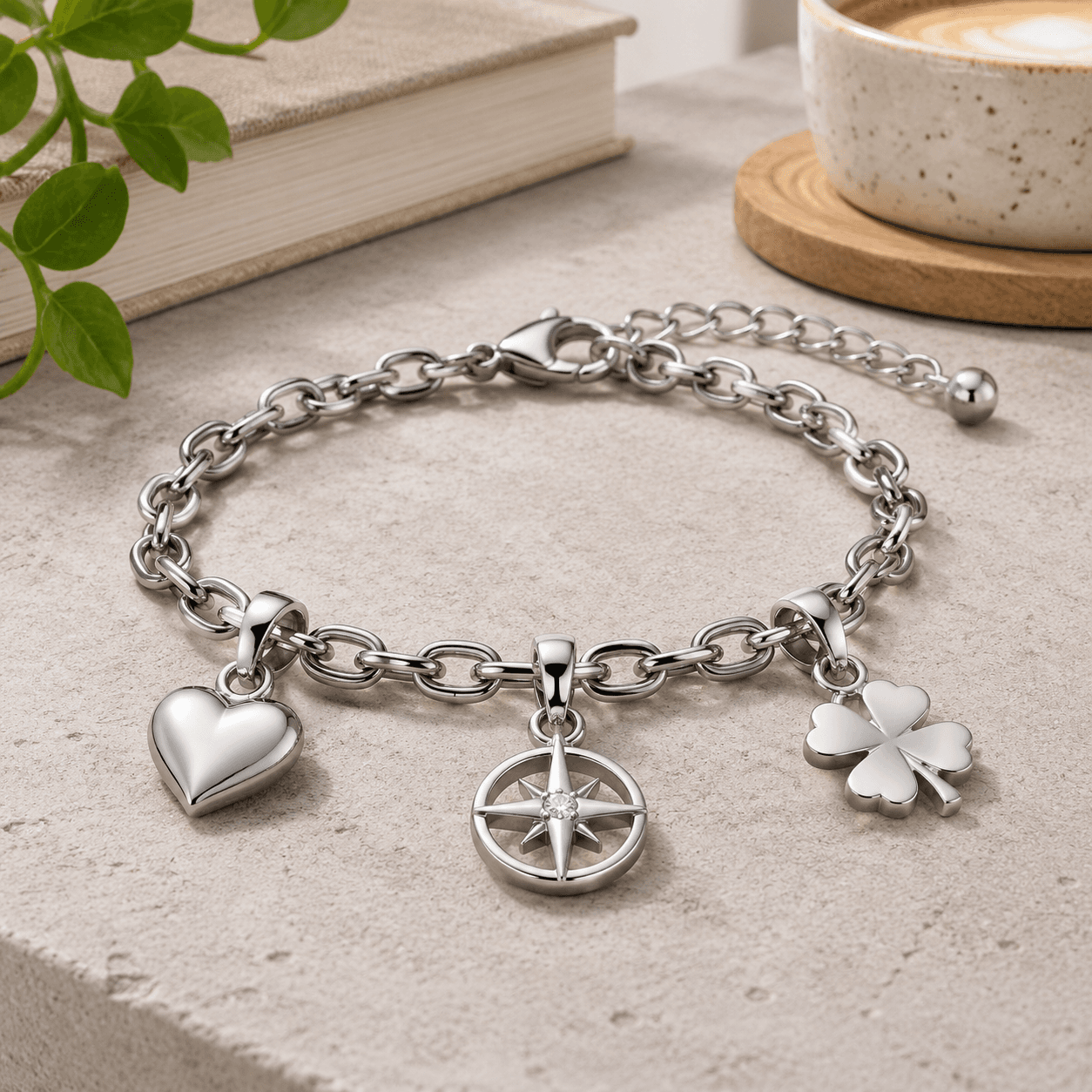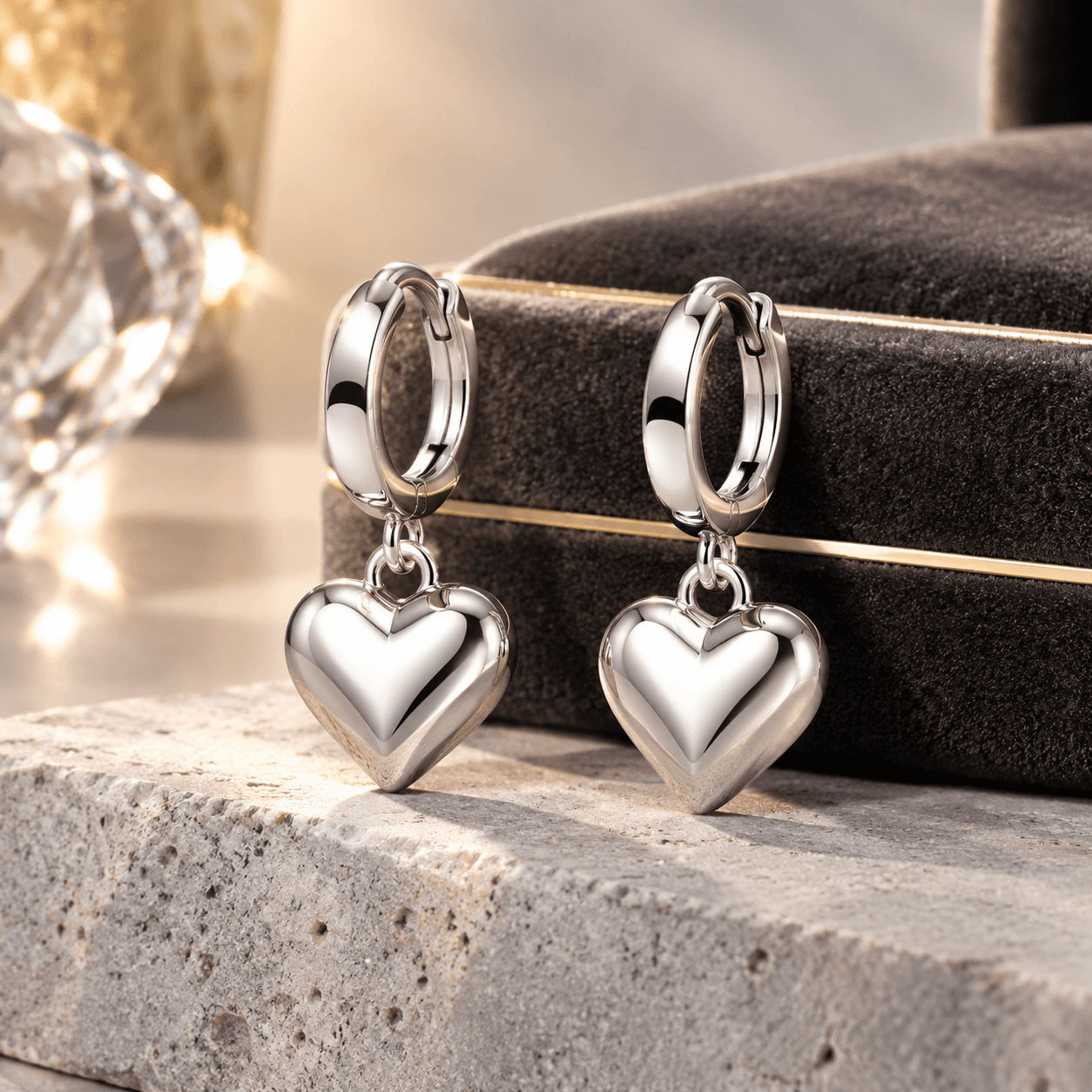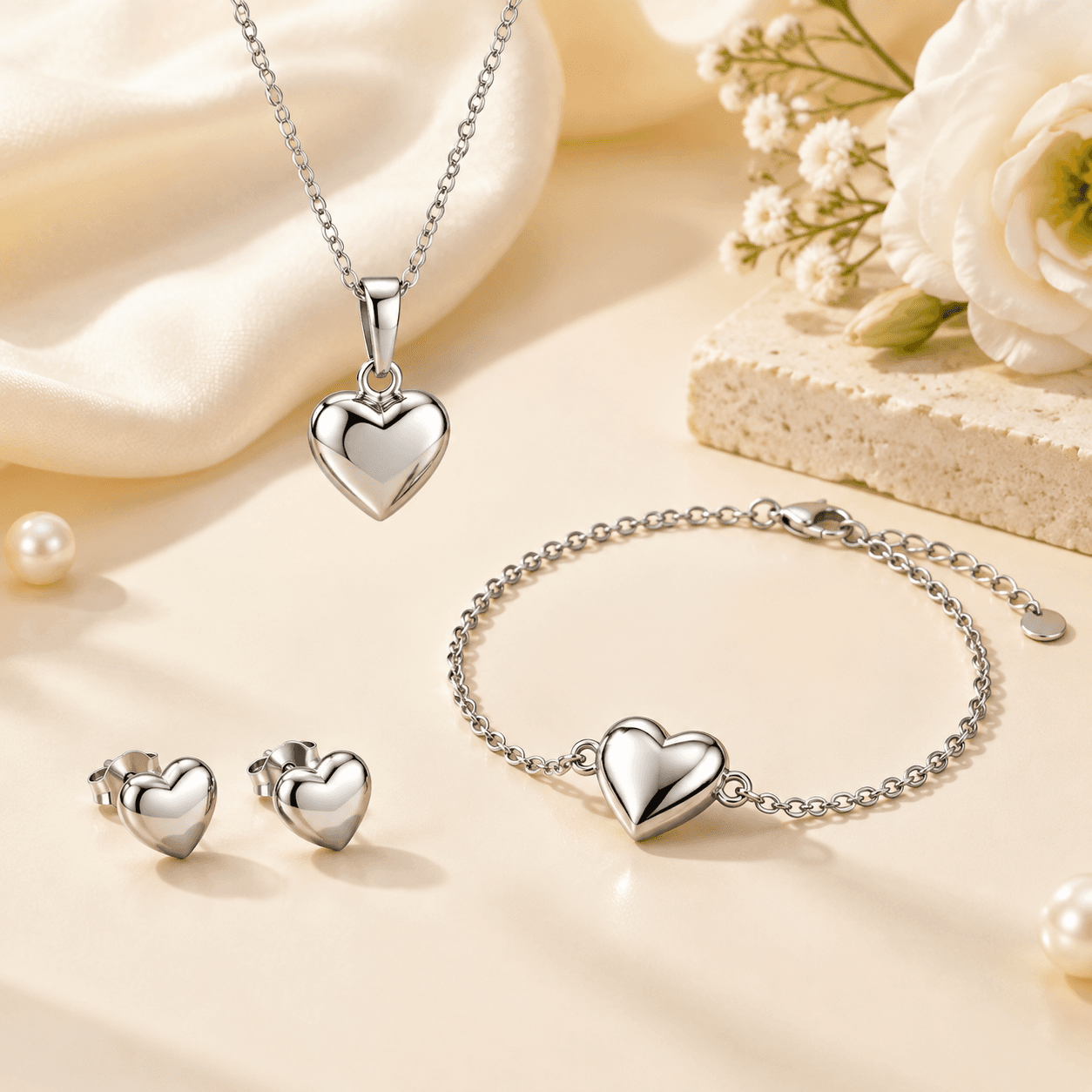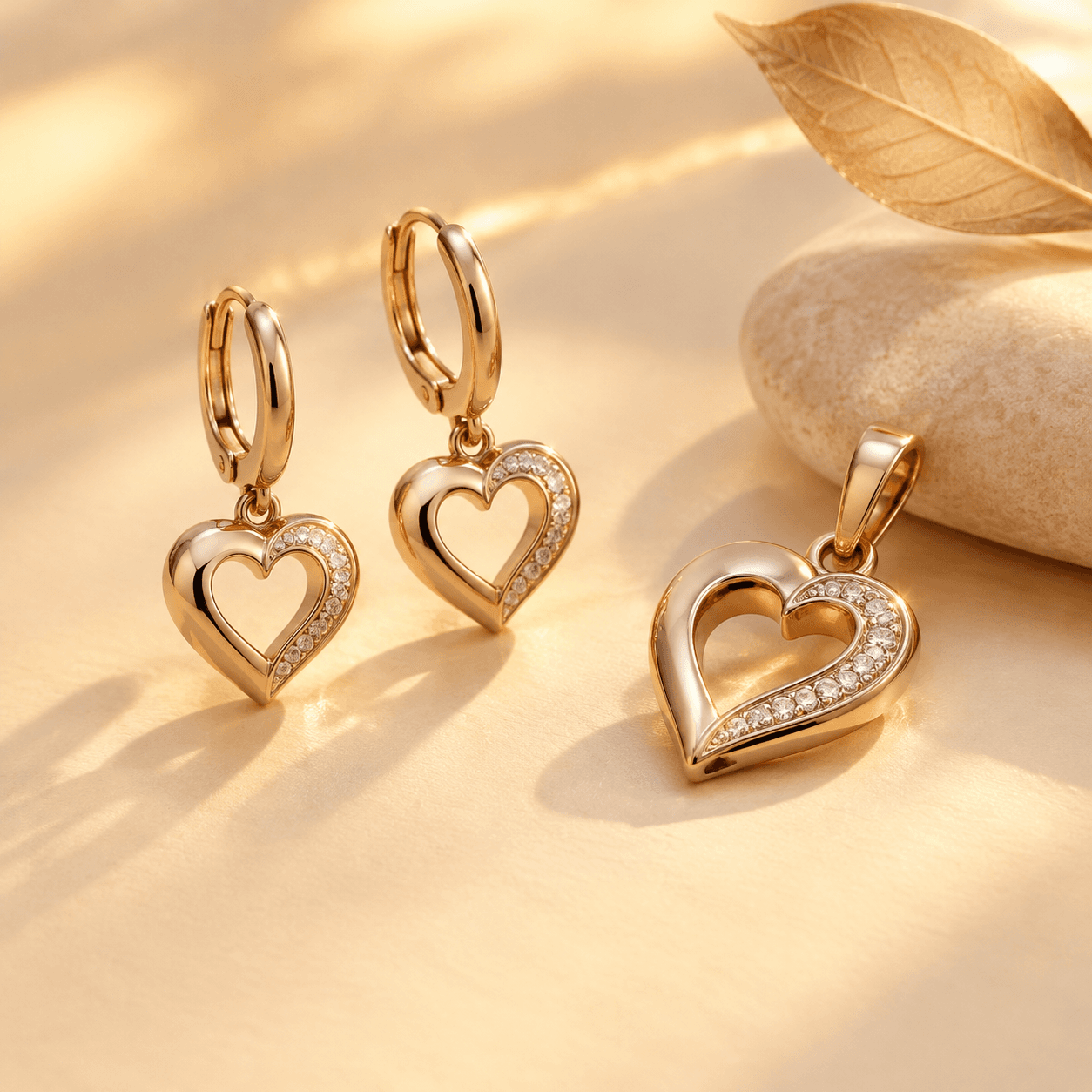
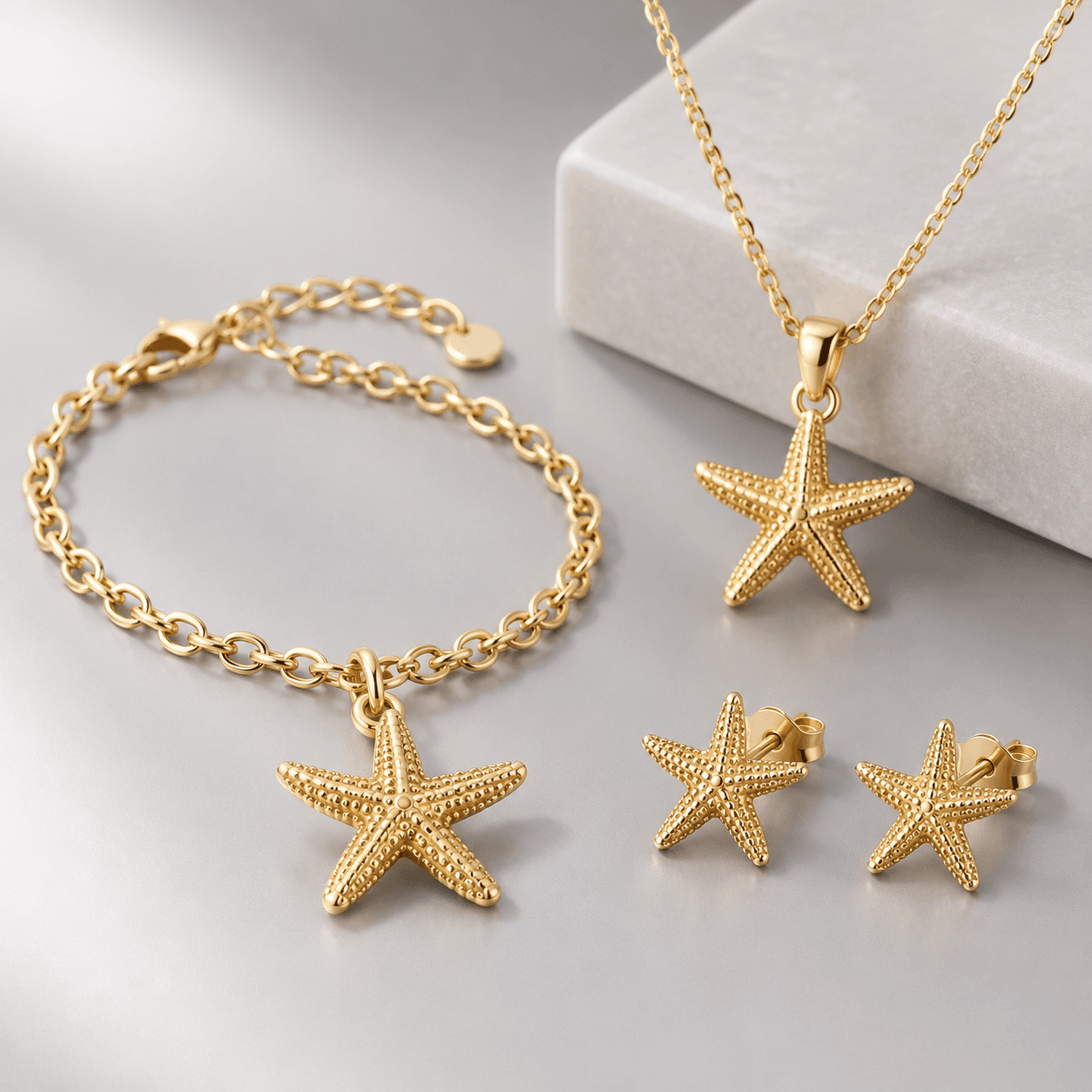
A starfish charm bracelet combines marine-inspired design with practical jewelry engineering. For jewelry designers developing a boutique jewelry collection, private label jewelry range, or wholesale jewelry program, material selection influences appearance, structural integrity, surface finishing, and long-term product consistency. Understanding how stainless steel grades, decorative finishes, charm geometry, and attachment hardware work together helps turn an initial design concept into a manufacturable product.
This material guide examines the technical considerations behind a custom starfish charm bracelet, from selecting 316L stainless steel and evaluating PVD gold plating to planning sampling, stone setting, and quality control. Buyers can use these manufacturing considerations when discussing design development, sample production, CNC and laser processing, polishing, finishing, inspection, custom logo work, and packaging with Lefeng Jewelry or another qualified supplier. The aim is to prepare more precise specifications and develop commercially practical collections.
Verständnis der Materialanforderungen eines Seestern-Charm-Armbands
The first step in designing a starfish charm bracelet is understanding how the base material influences the finished product. Stainless steel is a practical option for jewelry designers who need a defined metal appearance, consistent component geometry, and flexibility across different bracelet constructions. Within stainless steel options, 316L stainless steel and 304 stainless steel should be evaluated according to the intended product specification, component function, finishing requirements, and target market expectations.
316L stainless steel is particularly relevant when a design requires a refined metal surface and a carefully specified material composition. Its chromium content contributes to the formation of a passive surface layer, while its molybdenum content distinguishes it from common 304 stainless steel. These material characteristics are relevant to corrosion-resistance considerations, although actual product performance depends on the complete alloy specification, manufacturing process, surface condition, and intended environment. Designers should avoid treating a material grade alone as proof of a finished bracelet's performance.
For a starfish charm bracelet, the base material must also suit the dimensions and construction of the decorative element. A small starfish charm may require fine surface detailing, while a larger charm may need a different thickness and attachment configuration. During supplier discussions, buyers can review design development, sampling, polishing, inspection, and other requested processes against the confirmed project scope. Buyers can also review the available stainless steel bracelet collection when evaluating product structures and potential development directions.
Geometrie, Struktur und Fertigungsaspekte von Seestern-Anhängern
The starfish silhouette is an important design feature, but its manufacturability depends on more than the external outline. Designers should consider the number of arms, central body proportions, edge definition, surface relief, thickness, and attachment position. Five-arm silhouettes are a familiar design direction, but the proportions can be adjusted to create different visual identities. Rounded arms produce a softer appearance, while more defined contours create a sharper decorative profile. The chosen geometry should remain practical for the intended production and finishing processes.
Thickness and structural transitions deserve particular attention. Very narrow sections near the starfish arms may require additional design review because they can affect handling, polishing access, and the consistency of the finished outline. Recessed details and raised textures should also be considered in relation to tooling and finishing. CNC and laser processing can support the development of defined shapes and details, while polishing helps refine accessible surfaces. The appropriate manufacturing approach depends on the approved drawing, dimensions, and required surface appearance.
Attachment engineering is equally important. A starfish charm may connect to a bracelet through a properly sized jump ring, integrated loop, or another specified connection. The connection should be positioned to support natural movement without creating an unintended orientation or restricting adjacent bracelet components. Designers should provide the intended charm orientation, loop dimensions, connection clearance, and bracelet construction in their technical brief. For additional design directions, review Lefeng Jewelry's stainless steel charms and new jewelry designs.
PVD-Goldbeschichtung und dekorative Oberflächenveredelungen auswählen
Die Oberflächenveredelung hat einen wesentlichen Einfluss auf den visuellen Charakter eines Seestern-Charm-Armbands. Eine polierte Edelstahloberfläche erzeugt eine klare metallische Optik, während eine PVD-Goldbeschichtung eine goldfarbene Oberfläche schafft, die eine wärmere Ausrichtung der Kollektion unterstützen kann. Eine Roségoldbeschichtung bietet eine weitere mögliche Veredelungsoption. Designer sollten die Veredelungen entsprechend der Gesamtfarbpalette der Kollektion, der vorgesehenen Positionierung im Einzelhandel und der visuellen Beziehung zwischen Charm, Armbandkette und Verbindungskomponenten auswählen.
PVD, also die physikalische Gasphasenabscheidung, ist eine Beschichtungstechnologie, bei der Material unter kontrollierten Vakuumbedingungen auf eine vorbereitete Oberfläche aufgebracht wird. In der Schmuckherstellung ist die PVD-Goldbeschichtung relevant, da sie ein Verfahren zur Erzeugung einer dekorativen goldfarbenen Oberfläche bietet. Das Endergebnis hängt jedoch von der Vorbereitung des Substrats, der Oberflächenreinheit, der Beschichtungsspezifikation, der Bauteilgeometrie und der Prozesskontrolle ab. Ein technisch detailliertes Design sollte daher die gewünschte Veredelung, die Farbreferenz, den Glanzgrad und die Frage spezifizieren, ob alle Armbandkomponenten die gleiche Behandlung benötigen.
Die Oberflächenvorbereitung ist ein wesentlicher Bestandteil der Entwicklung der Veredelung. Polierspuren, Kanten, Vertiefungen und Befestigungsbereiche können das Erscheinungsbild der fertigen Beschichtung beeinflussen. Designer sollten Muster unter gleichbleibenden Lichtverhältnissen prüfen und sowohl die Hauptdekorfläche als auch weniger sichtbare strukturelle Oberflächen untersuchen. Wenn ein Projekt bestimmte Beschichtungsdokumentationen oder Leistungsnachweise erfordert, sollten die entsprechenden Anforderungen vor der Produktion festgelegt werden. Lefeng Jewelry kann die angeforderte Spezifikation prüfen und die anwendbare Dokumentation für die bestätigte Konfiguration besprechen, anstatt davon auszugehen, dass alle Veredelungen identische Eigenschaften aufweisen.
Für ein abgestimmtes Produktsortiment können Designer, sofern dies mit der genehmigten Konstruktion vereinbar ist, auch Emaille-, Zirkon-, Kristall- oder Perlendetails in Betracht ziehen. Jedes zusätzliche dekorative Element bringt eigene Anforderungen an die Fassung und Prüfung mit sich. Ziel ist es, eine Veredelungsspezifikation festzulegen, die klar kommuniziert, durch einen vereinbarten Prozess reproduziert und anhand eines freigegebenen Musters überprüft werden kann.
Kombination aus Textur, Farbe und dekorativen Details
Ein Seestern-Anhängerarmband bietet zahlreiche Möglichkeiten für kreative Individualisierung, ohne die grundlegende Produktkategorie zu verändern. Die Oberfläche des Anhängers kann mit glatt polierten Bereichen, vertieften Linien, erhabenen Texturen oder sorgfältig definierten Konturen gestaltet werden. Diese Veredelungen beeinflussen, wie das Licht mit dem Metall interagiert und wie deutlich die Seesternform erkennbar ist. Designer sollten entscheiden, welche Details für die visuelle Identität wesentlich sind und welche die Fertigung erschweren könnten, ohne einen echten Mehrwert zu bieten.
Mit Emaille lassen sich gezielte Farbakzente in ausgewählten vertieften Bereichen setzen, während Zirkon und Kristall durch geeignete Fassungsstrukturen dekorative Blickfänge schaffen können. Perlenelemente können ebenfalls in Betracht gezogen werden, wenn das Design einen weicheren dekorativen Kontrast erfordert. Jede Option benötigt einen spezifischen Platzierungsplan. Beispielsweise kann ein kleiner zentraler Stein eine passende Auflage und eine sichere Fassungskonstruktion erfordern, während Emaille geeignete Vertiefungsmaße und saubere Begrenzungen benötigt. Diese Details sollten auf Grundlage der tatsächlichen Komponentenabmessungen entwickelt werden, anstatt sie nach der Fertigstellung der Hauptstruktur hinzuzufügen.
Konzepte mit verschiedenen Materialien erfordern besondere Aufmerksamkeit an den Schnittstellen. Ein Armband kann strukturelle Komponenten aus Edelstahl mit einem dekorativen Element aus einem anderen vorgesehenen Material wie 925er Sterlingsilber, Kupfer oder Zinklegierung kombinieren. Solche Kombinationen sollten entsprechend der funktionalen Rolle jeder Komponente, der Fügemethode, der Oberflächenbehandlung und der Prüfanforderungen bewertet werden. Die Materialliste und die Verantwortlichkeiten für die einzelnen Komponenten sollten in der freigegebenen Spezifikation klar dokumentiert werden, damit Käufer genau verstehen, was gefertigt wird.
Designer können eine stimmige Kollektion entwickeln, indem sie eine einheitliche dekorative Gestaltungssprache auf Armbänder, Halsketten, Ohrringe und Ringe anwenden. Ein Seesternmotiv kann zum zentralen visuellen Element werden, während Unterschiede in Größe, Oberflächenbehandlung und Steinplatzierung für Variationen zwischen den Produkten sorgen. Entdecken Sie bei der Planung einer koordinierten Produktentwicklung das Sortiment an Edelstahl-Halsketten, Edelstahl-Ohrringen und Edelstahl-Ringen.
Armbandketten-Design, Platzierung von Anhängern und tragbare Proportionen
The bracelet structure determines how the starfish charm sits, moves, and interacts with the wrist. Designers can consider chain bracelets, link-based constructions, or other suitable bracelet formats according to the desired appearance and approved manufacturing design. Chain link dimensions, bracelet length, extension chain configuration, and closure selection should be evaluated together. A decorative charm that appears balanced in a standalone drawing may look different when attached to a moving bracelet, so the complete assembly should be reviewed during sampling.
Charm placement affects both visual balance and product functionality. A central starfish charm creates a clear focal point, while multiple decorative elements can distribute visual interest along the bracelet. The attachment loop and jump ring must have suitable proportions for the charm and chain. Excessively restricted movement may cause the charm to sit awkwardly, while an unsuitable connection arrangement may allow unwanted rotation. The intended movement and orientation should therefore be demonstrated in the sample rather than judged only from a flat design image.
Closure selection is another practical consideration. A lobster clasp is a separate bracelet closure positioned at the appropriate chain end, not an attachment component that connects directly to the starfish charm. Its dimensions should be suitable for the bracelet chain and the intended user experience. Extension chains can provide adjustment flexibility when included in the design. Designers should specify closure type, connection dimensions, chain length, and extension length independently so that each component can be evaluated during production.
Before confirming a design, review the complete bracelet on a flat surface and in a natural curved position. Check that the starfish charm remains visually balanced, connecting rings are properly attached, the clasp operates as intended, and no component interferes with another. This assembly-focused approach helps a stainless steel jewelry manufacturer identify design adjustments before the project moves beyond sample development.
Musterentwicklung: Vom Konzept eines Seestern-Anhängers zur Produktionsspezifikation
Sampling is the stage where a jewelry designer can evaluate whether a creative concept translates into a practical manufacturing structure. A useful starfish charm bracelet development brief should include a reference drawing or visual concept, overall bracelet dimensions, charm measurements, material grade, surface finish, connection details, and any decorative requirements. If the design includes enamel, zircon, crystal, or pearl, the location and construction of each decorative feature should also be documented. More complete information reduces ambiguity during technical review.
During an OEM or ODM supplier discussion, the project may progress from concept review to sample production through design development, CNC and laser processing, polishing, PVD or other configured finishing, decorative setting, and sample inspection, subject to the confirmed project scope. Designers should treat the first sample as an opportunity to review both appearance and construction. The charm silhouette, metal thickness, surface transitions, attachment position, chain proportions, and closure arrangement should be compared with the original design intention.
Sample feedback should be specific and measurable wherever possible. Instead of requesting a charm that simply looks more balanced, provide the preferred position, dimension, proportion, or drawing revision. Instead of requesting a better gold color, provide a physical finish reference or an agreed color specification. This makes communication between the design team and factory more productive. Any revisions should be recorded so that the approved sample and production specification remain aligned.
Designers developing a private label jewelry range should also consider the commercial structure during sampling. The intended quantity, packaging requirements, logo placement, product variations, and target markets may affect the final specification. MOQ should be discussed against the actual design, material configuration, process requirements, and order scope rather than assumed to be identical for every product. Learn more about the available OEM and ODM manufacturing services and prepare project information for an initial technical discussion.
Qualitätskontrollpunkte für ein Großhandelsarmband mit Seestern-Charm
Quality control should cover the complete bracelet rather than concentrating only on the decorative starfish charm. A structured inspection approach begins with specification confirmation. The material grade, component dimensions, finish reference, connection structure, and approved sample should be available as the basis for review. Where multiple components use different configured materials or finishes, their individual specifications should be recorded clearly. This creates a practical reference for evaluating incoming materials, work-in-progress components, and assembled products.
During component processing, relevant inspection points include the starfish outline, arm proportions, edge condition, surface smoothness, recess definition, and attachment-loop geometry. Polishing should be reviewed for visible inconsistencies, while finished surfaces should be examined for unwanted marks and differences against the approved reference. For PVD gold plating and rose gold plating, the agreed visual finish should be checked across the relevant components. Decorative settings should be inspected for positioning and visible construction issues according to the approved design.
Final assembly inspection should examine bracelet length, chain connections, jump rings, charm movement, clasp operation, extension chain attachment, and overall appearance. Packaging review should confirm that the selected packaging configuration matches the order specification and that the product is presented appropriately for handling and shipment. These checkpoints are practical process controls, not a substitute for project-specific laboratory testing or external certification.
For buyers supplying products to the US, EU, UK, Canada, or Australia, regulatory and documentation requirements should be identified according to the destination market, product composition, and intended claims. If a certificate, material declaration, coating report, or specific test result is required, the buyer should identify the applicable standard and documentation scope during the RFQ stage. Lefeng Jewelry can review or discuss documentation arrangements for the confirmed specification. Any supplier's in-house inspection and finishing processes should be distinguished from external certification or independent test evidence.
For further buyer education, see manufacturing and sourcing insights, including material selection, bracelet inspection, and finishing considerations. A clear quality checklist gives designers and sourcing teams a shared basis for approving samples and reviewing production requirements.
Eine kommerziell praktikable Private-Label-Armbandkollektion entwerfen
A successful starfish charm bracelet collection should combine creative differentiation with a specification that can be manufactured and reviewed consistently. Designers can establish a core product structure and develop variations through charm dimensions, metal finishes, decorative accents, chain proportions, and packaging presentation. This approach allows a collection to maintain a recognizable design direction without requiring every variation to introduce an entirely different manufacturing structure.
For example, a collection may use one approved bracelet construction with different starfish charm surface treatments. One version could emphasize a polished stainless steel surface, while another could feature PVD gold plating. A further variation could introduce an enamel detail or a specified zircon setting. The feasibility of each variation should be evaluated according to processing requirements and the complete product specification. Designers should also consider whether the selected finishes and decorative details can be applied consistently across all related components.
Commercial planning should begin before the final sample approval. Buyers should establish the anticipated order quantity, SKU structure, packaging format, logo requirements, target retail positioning, and delivery-market documentation needs. A low MOQ request should be discussed in relation to the selected material, tooling or development requirements, finishing processes, and packaging configuration. Different variations may have different production considerations, so the factory should review the complete order plan rather than evaluate a single product image.
Buyers can discuss private-label development requirements with Lefeng Jewelry, including sampling, logo placement, packaging, inspection arrangements, and export documentation, subject to the confirmed project scope. Review the Lefeng Jewelry factory and company information to understand the available company information and prepare a project discussion. For a broader range of product options, explore the stainless steel bracelets collection before preparing a product list or RFQ.
Häufig gestellte Fragen zu den Materialien von Seestern-Charm-Armbändern
Starten Sie die Entwicklung Ihres individuellen Seestern-Charm-Armbands
Ready to turn your starfish charm bracelet concept into a practical private label jewelry product? Share your design reference with Lefeng Jewelry for an initial manufacturing discussion. Buyers can discuss OEM and ODM design development, sample production, CNC and laser processing, polishing, PVD and plating, decorative setting, quality inspection, custom logo work, packaging, and export coordination according to the confirmed project scope.
For a useful RFQ, include your preferred material grade, such as 316L stainless steel or 304 stainless steel; charm dimensions and thickness; bracelet length and chain structure; connection and clasp requirements; desired surface finish; and any enamel, zircon, crystal, or pearl details. Attach technical drawings, reference photographs, color specifications, or an existing sample where available. Also indicate your target quantity, expected MOQ, number of design variations, logo requirements, packaging preferences, destination market, and any required material or product documentation.
If you are still developing the concept, Lefeng Jewelry can review the available information and discuss practical sample development considerations before the final specification is approved. You can contact our team for an RFQ, browse new stainless steel jewelry designs, or add relevant products to your quote list. A clear brief is the starting point for evaluating materials, confirming construction details, and developing a bracelet that reflects your collection requirements.
Related resources
Related resources
- How to Evaluate Quality in Stainless Steel Charm Bracelets
- Why Is Stainless Steel Heart Charm Waterproof? 316L Guide
- Best Stainless Steel Heart Charm Ideas: A Buyer's Design Guide
- Stainless steel jewelry gift ideas: Retail design trends guide
- Is Stainless Steel Jewelry Waterproof? Quality Tests Guide
- Seasonal Charm Collection Guide for OEM Jewelry Buyers
- Seasonal Charm Collection: OEM Jewelry Trends for Brands
- Jewelry Parts: A Practical Guide for OEM/ODM Manufacturing
- Stainless Steel Heart Charms: A B2B Buyer’s Guide to Premium Finishes
- Seasonal Charm Collection: Premium OEM Stainless Steel