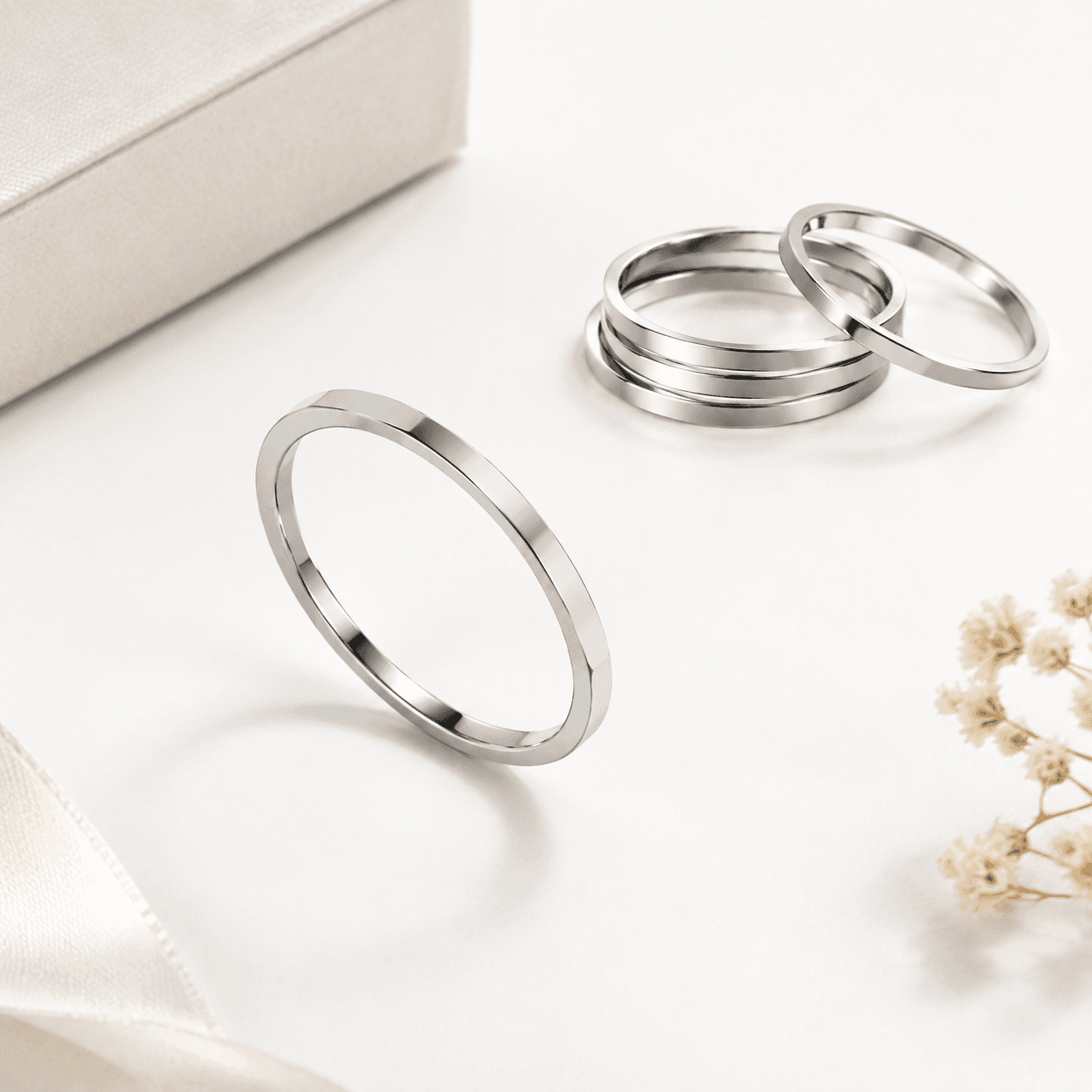
1mm stainless steel stackable rings are a minimalist jewelry option for retailers, wholesalers, and private label brands developing delicate everyday jewelry collections. Their narrow profiles work well as standalone pieces or as part of coordinated ring assortments. However, producing a commercially suitable slim ring requires more than selecting an attractive design. Band width, thickness, material grade, construction, surface finishing, sizing, and quality inspection all influence the finished product.
This guide explains the key specifications to evaluate when sourcing 1mm stackable rings, including 316L and 304 stainless steel, polished surfaces, PVD finishing, dimensional consistency, and custom packaging. It also outlines practical considerations for OEM and ODM development, from reference drawings and sample approval to bulk production specifications. Jewelry businesses can explore the stainless steel rings collection for product inspiration and assortment planning.
Why 1mm Stackable Rings Are a Practical Addition to Jewelry Collections
A 1mm stackable ring offers a minimal silhouette that complements contemporary jewelry collections. Its narrow band can be worn individually or combined with other rings, making it suitable for minimalist, layering, everyday, and gift-oriented product ranges. For jewelry retailers and private label brands, this versatility creates opportunities to develop coordinated collections with different finishes, sizes, and complementary designs.
However, a delicate appearance should not be confused with structural durability. A 1mm-wide ring has limited material across its width, and its resistance to deformation also depends on band thickness, geometry, material properties, and manufacturing quality. Buyers should therefore distinguish the stated band width from its thickness and cross-sectional profile when evaluating a product. These dimensions should be specified separately in technical drawings or sample requirements.
Stainless steel is one material option for developing practical everyday jewelry designs. Common sourcing choices include 316L and 304 stainless steel, although the appropriate specification depends on the intended product and market requirements. Finishing options may include polished stainless steel, PVD gold finishing, or configured rose gold finishes, subject to the manufacturing process. Buyers can explore the new design collection for additional product concepts when planning a private label or wholesale ring assortment.
For OEM and ODM projects, the initial design brief should establish the target dimensions, material, surface finish, ring sizes, and intended positioning. These details provide a clearer basis for evaluating manufacturing feasibility and developing a representative sample before bulk production.
Five Technical Specifications to Check When Sourcing 1mm Rings
1. Band width and thickness. A 1mm band width is approximately 0.039 inches. Because this is an especially slim profile, buyers should confirm the actual width and specify the band thickness separately. Product photographs are not sufficient for verifying dimensions. Request technical measurements and a physical sample when dimensional accuracy is important.
2. Edge profile and construction. Confirm whether the design uses a flat, rounded, or other specified edge profile. Examine the outer surface, inner opening, and overall circular shape. Edges should be consistently finished, without obvious irregularities. The agreed construction and dimensions should be documented before sample approval.
3. Stainless steel grade. Specify whether the proposed material is 316L stainless steel, 304 stainless steel, or another agreed material. Ask the manufacturer to confirm the material specification for the actual product rather than relying on a general stainless steel description. Any documentation requirements should be communicated during the RFQ stage.
4. Surface finishing. Polished stainless steel, PVD gold finishing, and rose gold finishing offer different visual appearances. Confirm the intended color, surface appearance, and finishing specification. Compare the production sample with the approved reference and inspect for visible marks, uneven color, or finishing inconsistencies. Performance requirements should be agreed separately rather than inferred from the finish name.
5. Ring sizing and dimensional consistency. Confirm the inner diameter, corresponding ring size, band width, thickness, and whether the design is a closed band or adjustable style. A consistent measurement method is important when developing multiple sizes for a wholesale collection. If adjustable construction is proposed, its feasibility should be reviewed against the design and intended use.
For commercial development, these specifications should form part of the sample approval checklist. An OEM or ODM jewelry manufacturer can review reference photographs, technical drawings, material preferences, finishing requirements, logo placement, and packaging details before confirming project feasibility. Learn more about available project coordination through OEM and ODM manufacturing services.
How to Evaluate Durability and Quality Control in Slim Stainless Steel Rings
Durability assessment for a 1mm stackable ring should consider the complete product specification rather than relying on its material name or appearance. A narrow band may be more susceptible to bending under concentrated pressure than a wider design. Its actual behavior depends on material properties, band thickness, cross-sectional geometry, processing, and intended wearing conditions.
During sample evaluation, buyers should examine several practical characteristics:
- Dimensional consistency: Check band width, thickness, inner diameter, and overall profile against the approved drawing or specification.
- Shape consistency: Inspect whether the ring maintains the intended circular form without obvious distortion.
- Edge finishing: Review the inner and outer edges for visible irregularities and rough finishing.
- Surface quality: Examine the polished or plated surface for visible marks, uneven appearance, or inconsistent color.
- Construction: Confirm that the finished sample matches the agreed design and structural requirements.
For 316L or 304 stainless steel products, buyers should request confirmation of the specific material grade. Material selection alone does not establish the durability of the finished ring. If PVD gold or another configured finish is selected, the intended appearance and applicable inspection requirements should also be documented.
At the manufacturing level, quality control checkpoints can include incoming material specification review, dimensional inspection, shape evaluation, polishing and finishing checks, and final product inspection before packaging. Additional testing or technical documentation should be agreed separately according to the buyer's requirements. Visual inspection should not be presented as equivalent to laboratory testing or independently verified performance.
For wholesalers and private label businesses, a useful approach is to establish measurable acceptance criteria before sample approval. This makes it easier to compare the approved sample with subsequent production and communicate consistent product specifications across purchasing, merchandising, and quality control teams.
Custom Finishes, Private Label Packaging, and Wholesale Cost Factors
For a commercial jewelry collection, the presentation of a 1mm stackable ring should be considered alongside its dimensions and finish. Packaging options may include individual jewelry boxes, presentation cards, protective pouches, and customized gift packaging. The appropriate format depends on the retail positioning, target customer, shipping requirements, and intended product presentation.
Private label buyers can consider several packaging specifications, including custom logo placement, printed artwork, insert design, box dimensions, and individual product protection. For coordinated collections, packaging dimensions should accommodate the ring and any accompanying jewelry pieces. Request packaging references or samples before approval, and confirm which components are included in the quotation.
Wholesale pricing should be evaluated against the complete product specification rather than band width alone. Important cost factors include:
- Specified stainless steel grade and material consumption.
- Ring width, thickness, size range, and construction.
- Polishing requirements and selected PVD or plating finish.
- Logo engraving and other customization requirements.
- Packaging materials, artwork, and individual packing.
- Order quantity, shipping arrangements, and destination market.
There is no universal wholesale price for a 1mm stainless steel ring because different specifications and order requirements can result in different quotations. Buyers should provide a clear product brief and estimated order quantity when requesting pricing. The quotation should identify the applicable product specification, customization costs, packaging scope, and commercial terms.
Before placing a bulk order, also review payment arrangements, production terms, shipping responsibilities, customer service contacts, and written procedures for defective or nonconforming products. For additional company background, visit Lefeng Jewelry's factory and company information.
Frequently Asked Questions About 1mm Stainless Steel Stackable Rings
OEM and ODM Development Process for Custom Thin Stainless Steel Rings
Developing a commercially suitable 1mm stackable ring requires coordination between the design concept, material selection, dimensional requirements, and manufacturing feasibility. For OEM and ODM projects, a clear development process helps buyers evaluate the proposed design before committing to bulk production.
Step 1: Submit the product brief. Identify the intended market, design concept, target band width, thickness, ring size range, preferred material, surface finish, estimated order quantity, and packaging requirements. Reference photographs, sketches, CAD drawings, or physical samples can help communicate the intended appearance.
Step 2: Review technical feasibility. The manufacturer should review the proposed dimensions, edge profile, construction, material specification, and selected finishing process. For an especially slim 1mm design, band thickness and structural requirements deserve particular attention. Any adjustments needed for manufacturing should be discussed before sample development.
Step 3: Develop and evaluate samples. A sample provides an opportunity to inspect actual band width, thickness, inner diameter, edge consistency, surface smoothness, and finish appearance. Buyers should also review requested logo details and packaging compatibility. Any revisions should be documented and approved before production specifications are finalized.
Step 4: Confirm production and inspection requirements. Once the sample and specifications are approved, the buyer and manufacturer should agree on the applicable material requirements, dimensional tolerances, finishing criteria, inspection checkpoints, packaging details, and commercial terms. Additional testing, certificates, or compliance documentation must be separately confirmed rather than assumed to be included.
Step 5: Coordinate packaging and shipment. Final product presentation, individual protection, carton arrangements, and export documentation should follow the confirmed order requirements. International buyers should establish shipping responsibilities and delivery arrangements before production begins.
Depending on the confirmed project scope, Lefeng Jewelry can discuss OEM and ODM stainless steel jewelry development, including design, sampling, processing, polishing, PVD or plating, logo customization, quality inspection, packaging, and export coordination. The availability and suitability of individual processes should be confirmed during the project review. Buyers can explore manufacturing and sourcing insights or submit project requirements through the Lefeng Jewelry contact page.
Request an OEM/ODM Quote for Custom Stainless Steel Stackable Rings
Planning a 1mm stackable ring for a wholesale assortment, boutique jewelry collection, gift program, or private label launch? Lefeng Jewelry welcomes project inquiries from businesses exploring stainless steel ring development. Share your design concept and purchasing requirements so the team can review the proposed specifications, discuss manufacturing feasibility, and identify the next steps for sampling and quotation.
For a more efficient RFQ review, prepare the following information:
- Design reference: Product photographs, sketches, CAD drawings, or an existing physical sample.
- Dimensions: Target 1mm band width, band thickness, edge profile, inner diameter, and required ring size range.
- Material: Preferred 316L stainless steel, 304 stainless steel, or another specified material.
- Surface finish: Polished stainless steel, PVD gold finish, rose gold finish, or another proposed finishing direction.
- Customization: Logo engraving, special surface details, and other design requirements, subject to technical feasibility.
- Commercial requirements: Estimated order quantity, target price range in USD, destination market, and purchasing schedule.
- Packaging: Gift boxes, presentation cards, individual packaging, logo artwork, and export packing preferences.
- Quality requirements: Dimensional criteria, inspection expectations, material documentation, and any project-specific testing or verification requirements.
Based on the submitted information, the team can discuss applicable MOQ, sampling arrangements, customization feasibility, and quotation requirements. Before approving a bulk order, buyers should obtain written confirmation of the final specifications, applicable commercial terms, production arrangements, packaging scope, and defect-handling procedures.
Learn more about the company through the About Lefeng Jewelry page or submit your project inquiry through Contact Us. A clearly defined product specification and approved sample provide a practical starting point for developing a consistent stainless steel ring collection.
Related resources
Related resources
- Why stainless steel rings outfit ideas Are Shaping Design Trends
- Stainless steel jewelry gift ideas: Retail design trends guide
- Best Stainless Steel Heart Charm Ideas: A Buyer's Design Guide
- Why Choose Stainless Steel Jewelry: A Retail Buyer Guide
- 316L Stainless Steel Earrings for Sensitive Ears: A B2B Buyer’s Quality Checklist
- Jewelry Parts: A Practical Guide for OEM/ODM Manufacturing
- What Buyers Should Know: Does Stainless Steel Heart Charm Tarnish
- Why Is Stainless Steel Heart Charm Waterproof? 316L Guide
- Lefeng Jewelry: OEM Stainless Steel Jewelry Manufacturing
- Is Stainless Steel Jewelry Waterproof? Quality Tests Guide