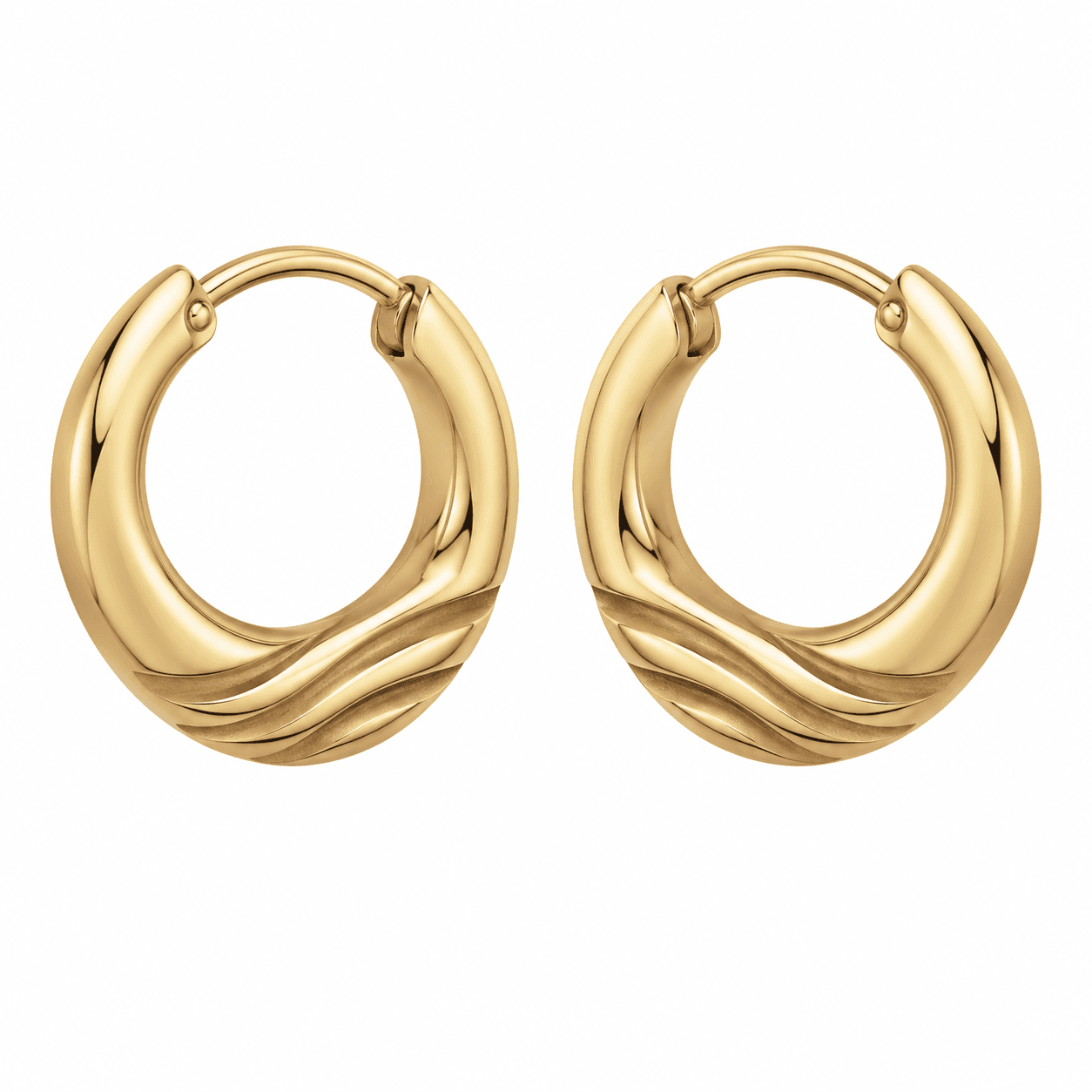
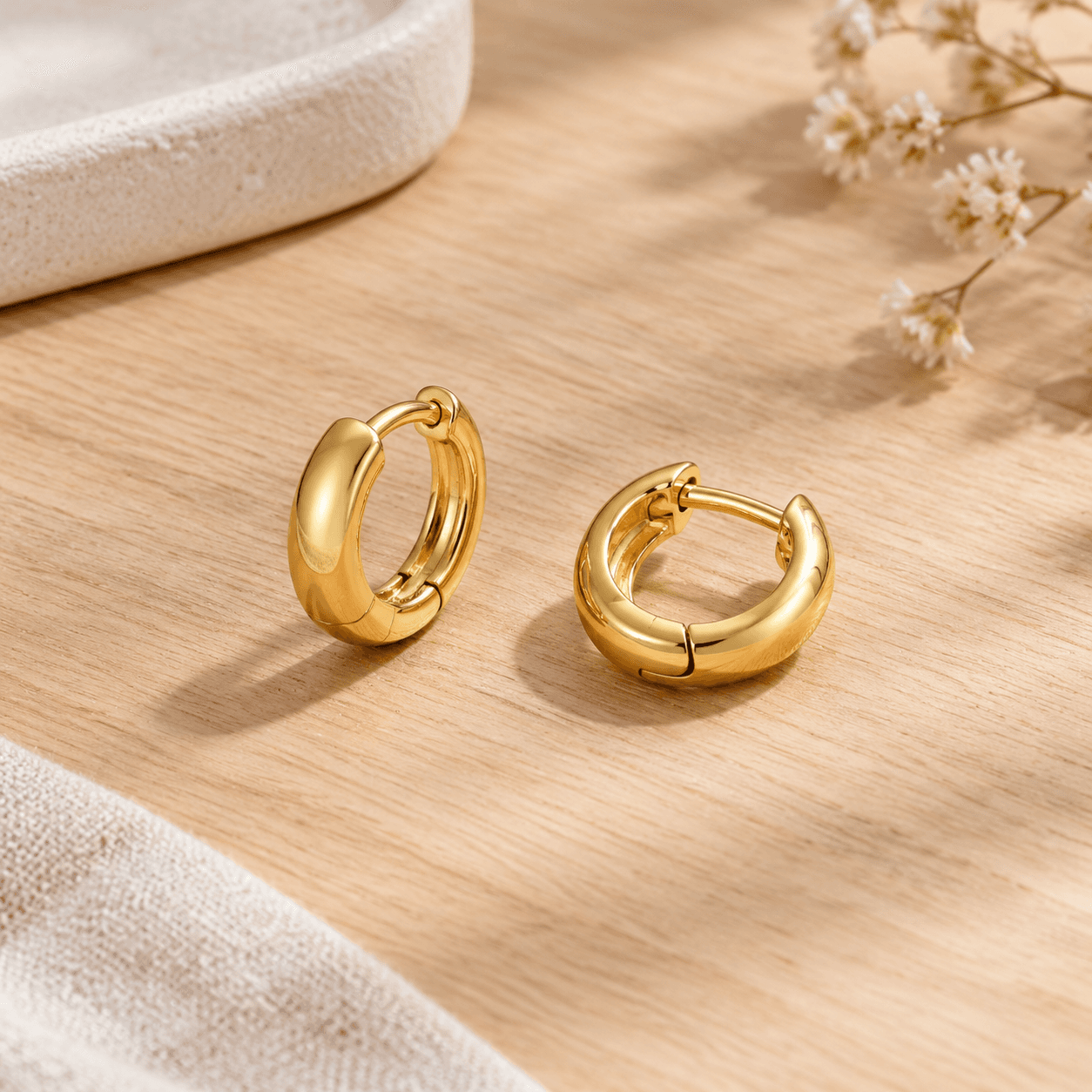
This B2B sourcing guide helps jewelry brands, wholesalers, boutique buyers, distributors, and online retailers plan OEM/ODM gold huggie hoop earring projects. It covers 316L stainless steel specifications, PVD gold finishing, sample development, dimensional tolerances, logo engraving, inspection criteria, private label packaging, MOQ planning, production scheduling, and RFQ preparation.
Lefeng Jewelry supports factory-direct development from design review and sampling through finishing coordination, inspection, private label packaging, and export coordination. Buyers can use the guide to define a measurable product specification, identify approval checkpoints, and prepare the information needed for a project-specific quotation. Any water-resistance or waterproof claim should be supported by an agreed product specification and appropriate verification before being used in marketing.
Gold Huggie Hoop Earrings: Defining the B2B Product Specification
For B2B buyers, a gold huggie hoop earring should be defined by a manufacturing specification, not just a product photograph. The RFQ should identify the base material, hoop dimensions, profile, opening and closure structure, surface finish, logo position, packaging requirements, estimated quantity, and sample approval criteria. For stainless steel designs, 316L stainless steel can be considered as the base material for polishing and PVD gold finishing. Confirm the material for each component, including the hoop, post, and closure, rather than assuming every part uses the same grade.
Huggie earrings have compact structures, so small differences in dimensions, polishing, or assembly can affect fit and closure operation. Buyers should specify acceptable tolerances and require the sample to demonstrate secure, repeatable opening and closing without sharp edges or visible assembly defects. CAD files, dimensioned drawings, physical references, finish samples, and logo artwork can help the manufacturer assess feasibility before sampling. Lefeng Jewelry can review the proposed design and coordinate sample development against the agreed requirements before bulk production is confirmed.
If the product is intended to be marketed as water-resistant or waterproof, define the intended use and the verification required for that claim. PVD finishing or a stainless steel base alone should not be treated as proof that a finished earring meets a particular waterproof performance standard.
316L Stainless Steel Specifications and Sample Development
Material selection should be documented before sampling begins. 316L stainless steel is a candidate base material for fashion earrings that require a polished surface and PVD gold finishing. The sourcing brief should specify the material grade for each relevant component, target dimensions, cross-sectional profile, wall thickness where applicable, surface texture, and acceptable dimensional tolerances. These details help a stainless steel jewelry factory assess the required tooling, machining or laser processing, polishing, assembly, and finishing steps.
Use a staged sample approval process to separate design decisions from production approval. The first sample can establish the shape, scale, closure operation, and logo position. A revised sample can then address details such as edge treatment, polishing, gold tone, and packaging fit. For collections with multiple sizes or related SKUs, document the approved specifications separately so that shared design features do not obscure differences in dimensions, components, finishes, or packaging.
Lefeng Jewelry can coordinate design feedback and sampling requirements with the buyer. Before approving a bulk order, retain the final drawing or specification, approved physical sample, material requirements, finish reference, logo artwork, and packaging details as the reference for production and inspection. Any changes after approval should be documented and assessed for their potential effect on cost, timing, and quality requirements.
PVD Gold Finish, Surface Quality, and Inspection Criteria
Gold-tone consistency matters when huggie earrings are purchased in wholesale quantities or developed as a coordinated collection. Buyers should approve a physical finish sample or a clearly defined reference and specify the expected appearance on exterior and interior surfaces, edges, and functional areas. Surface preparation before PVD finishing is also important because polishing marks and uneven surfaces can remain visible in the finished product. Record the acceptable color, reflectivity, texture, and edge definition so that the buyer and factory use the same approval standard.
Quality control should cover appearance, dimensions, function, and assembly. A project checklist can include hoop symmetry, dimensional tolerances, closure operation, post alignment, edge smoothness, polishing quality, PVD color consistency, logo legibility, and packaging fit. Buyers should agree on the inspection stage, sampling approach, acceptance criteria, and how nonconforming items will be handled before production starts.
Depending on the destination market and the product's intended claims, buyers may request applicable third-party testing, such as nickel-release testing, REACH-related compliance assessments, RoHS-related assessments where relevant, salt-spray testing, or coating-thickness measurement. The exact test method, sample configuration, acceptance criteria, and applicable regulatory requirements should be agreed for the product and market. Listing a test as a possible requirement does not establish that the product has passed it. Similarly, water-resistance or waterproof marketing claims require appropriate evidence for the finished product and the specific claim being made.
Wholesale Sourcing: MOQ, Private Label Packaging, and Lead Time
Commercial planning should begin during design development, not after sample approval. An RFQ for gold huggie hoop earrings should state the design or reference, material requirements, dimensions, finish, branding method, estimated quantity, packaging configuration, destination market, and target delivery window. MOQ and pricing depend on the actual construction, tooling, finishing, logo work, packaging, and order quantity, so request a project-specific quotation rather than relying on a generic figure.
For a new collection, separate sample development from bulk production. Confirm the sample scope, any applicable sample charges, revision process, final specification, packaging approval, and the conditions for authorizing mass production. If several SKUs share components or production processes, ask whether they can be coordinated while keeping the material, finish, branding, and packaging requirements of each SKU clearly documented.
Private label packaging may include branded cards, boxes, protective inserts, individual units, labels, and outer cartons, depending on the program. Confirm the artwork, dimensions, materials, logo placement, and packing configuration against the approved product before mass packing begins. The project schedule should account for design review, sampling, revisions, material preparation, production, finishing, inspection, packing, and export coordination. Ask the supplier to identify schedule assumptions and approval deadlines, since changes to quantity, finish, artwork, or packaging can affect the final delivery plan.
How to Evaluate an OEM/ODM Jewelry Supplier
Supplier evaluation should focus on the ability to develop and reproduce the approved product specification, rather than on a finished sample alone. Ask about experience with the proposed stainless steel construction, polishing and PVD finishing, closure assembly, logo engraving, sample revisions, inspection procedures, packaging coordination, and production communication. Confirm which manufacturing and finishing processes are handled in-house and which are performed by external partners. This helps buyers understand process ownership, coordination needs, and potential schedule dependencies.
OEM and ODM describe different development approaches. OEM is generally suitable when the buyer supplies the design or a detailed specification for the manufacturer to produce. ODM is generally suitable when the buyer wants the supplier to support design development using available or configurable product concepts. The actual scope should be agreed for each project, including design ownership, permitted modifications, tooling arrangements, branding, and approval responsibilities.
Before requesting a quotation, prepare a concise RFQ covering the product reference or drawing, dimensions, component materials, finish target, logo method, estimated order quantity, packaging requirements, destination market, inspection criteria, and target delivery window. Ask the supplier to clarify MOQ, sample charges where applicable, production timing, testing options, and export coordination for the specified configuration. Terms such as premium quality, durable finish, or waterproof should be translated into measurable requirements or appropriately verified claims. Written specifications and a retained approved sample provide a clearer basis for bulk inspection and repeat orders.
Buyer FAQ
Request an OEM/ODM Quote and Sample Review
To start an OEM/ODM gold huggie earring project with Lefeng Jewelry, send the product drawing or CAD file, target dimensions, material requirements, PVD gold finish reference, logo artwork, estimated order quantity, packaging brief, destination market, and desired delivery window. If you have a physical sample or visual reference, identify the features that must be retained and the areas that may be adjusted for manufacturability.
For a more complete RFQ, include your expected quantity range, requested sample quantity, inspection criteria, private label requirements, and any market-specific testing or substantiation needed for product claims. Ask for confirmation of the applicable MOQ, sample charges where relevant, proposed development stages, and project schedule for the specified configuration. Lefeng Jewelry can review the design, coordinate sample development and finishing, and outline the proposed quality-control checkpoints.
After the sample and production specification are approved, the documented requirements can guide bulk production, packaging, inspection, and export coordination. Contact Lefeng Jewelry to discuss your design and request a quotation based on the actual product requirements.
Related resources
Related resources
- Lefeng Jewelry - OEM/ODM Stainless Steel Jewelry Manufacturer
- Gold Plated Stainless Steel Jewelry: Durability and Sourcing Guide
- Why stainless steel rings outfit ideas Are Shaping Design Trends
- Stainless Steel Earrings
- Wholesale Stainless Steel Jewelry: Quality, Sourcing, and Private-Label Guide for OEM/ODM
- Best Stainless Steel Heart Charm Ideas: A Buyer's Design Guide
- Dashboard
- My account
- Shop
- Download